
Introduction
Dogs communicate primarily through body language, using a sophisticated system of visual signals that reveal exactly what they’re feeling and what they intend to do next. This complete dog body language guide breaks down every major signal-from tail position to facial expressions to subtle stress cues-so you can accurately read your dog’s emotional state in any situation.
This guide covers fundamental canine body language signals, emotional state interpretation, and advanced context-reading methods. It’s written for dog owners, families with dogs, and anyone working with reactive dogs or aggressive behavior who needs reliable, science-backed skills for deciphering dog body language. Whether you’re navigating a first dog park visit or managing leash reactivity on a Pittsburgh sidewalk, understanding how dogs communicate is the single most important skill you can develop for safety and training success.
Dog body language is a complex communication system involving tail position, ear placement, eye contact, body posture, and facial expressions that collectively reveal a dog’s emotional state and intentions. Dogs communicate through posture, facial expressions, movement, and small signals-and combinations of behaviors are often more informative than relying on a single cue.
By the end of this guide, you will be able to:
- Recognize stress and displacement behaviors before they escalate
- Identify early signs of aggression and defensive warnings
- Distinguish playful behavior from fearful or threatening body signals
- Interpret submission, appeasement behavior, and calming signals accurately
- Read context-dependent signals across different breeds and situations
Understanding Canine Communication Fundamentals
Dog body language is the primary communication method dogs use to express emotions, intentions, and comfort levels. Unlike human speech, canine communication relies on visual signals-posture, facial tension, tail and ear positions-supplemented by vocalizations and scent. Understanding dog body language requires a holistic view of the animal’s posture and movements, not just one isolated cue.
For training success and safety, accurate reading of body language is non-negotiable. This is especially true in off-leash obedience work and behavior modification for reactive or aggressive dogs, where misreading subtle signals often leads to escalation, bites, or uncontrolled reactivity.
Why Dogs Use Body Language
Canine communication evolved as a survival mechanism in social species. Wolves and wild canids developed elaborate body signals to coordinate pack behavior, establish social hierarchy, and resolve conflicts without physical harm. Domestic dogs retained this system, though domestication has modified signal clarity in some breeds-heavily furred dogs, those with docked tails, and brachycephalic breeds may show muted or obscured signals.
This evolutionary foundation means every dog, regardless of breed, uses body language as its default dog language. Your furry friend is constantly broadcasting information about how it feels-you just need to know where to look.
The Whole-Body Communication System
Dogs use their entire body from nose to tail tip as a unified communication system. A dog’s tail tells one part of the story, while the dog’s ears, eyes, mouth, and overall posture fill in the rest. No single signal operates in isolation. A wagging tail paired with a relaxed body means something entirely different from a wagging tail paired with a tense body and a hard stare.
This whole-body approach is critical because individual signals can be ambiguous on their own. A tail held high could mean confidence or aggression. Ears pinned back could indicate submission or intense focus during play. Only by reading multiple body signals together can you accurately assess what your dog feels. With this foundation in place, let’s examine each signal category in detail.
Essential Body Language Signals and Their Meanings
Now that you understand the whole-body communication framework, let’s break down the specific signals dogs use across each part of their body-and what those signals mean in context.
Tail Signals
The dog’s tail is one of the most expressive-and most misunderstood-parts of canine body language. A wagging tail indicates emotional arousal, not just happiness. This is one of the most common mistakes dog owners make: assuming any tail wagging means a happy dog.
Tail position and height communicate arousal and intention. A tail held high and rigid signals high arousal or a potential threat. A tail in a neutral position-roughly level with the back-suggests a relaxed dog. A tucked tail universally signals fear in dogs and indicates high levels of fear or stress.
Wagging speed and amplitude add another layer. A relaxed dog’s tail wags in wide, sweeping motions, while a fast-wagging tail with small, stiff movements often indicates tension or uncertainty. Dogs wag tails more to the right when feeling positive, according to lateralization research. Left-biased wags correlate with negative or anxiety-driven states, and other dogs actually perceive left-biased wags as more threatening.
A high, flagged tail can indicate aggression in dogs, particularly when combined with a stiff body and forward weight. Fearful dogs may tuck their tails before aggression, making the tail-tucked position an important early warning sign to watch for.
Facial Expressions and Head Positioning
A dog’s facial expressions reveal enormous amounts about its emotional state, though breed differences in skull shape and ear type can affect readability.
Eye contact patterns are among the most reliable indicators. Soft eyes-relaxed, partially squinted lids-indicate a dog is calm or happy. A relaxed dog has soft, squinty eyes with no visible tension around the brow. The exact opposite is a hard stare: a dog with hard eyes may feel aggressive, and dogs may show aggression with a fixed, hard stare. Between these extremes lies whale eye, where the whites of the eyes become visible along the sides. Whale eye shows a dog is feeling anxious or stressed and is a critical signal that the dog feels uncomfortable. A dog showing discomfort will often turn its head or look away, avoiding direct eye contact to prevent confrontation.
Ear position varies significantly by breed. Dogs with erect ears display clear forward-pricked positions when alert or interested. Dogs with floppy ears show subtler shifts. Regardless of breed, pinned back ears typically signify fear or submission in dogs. Ears in their natural position indicate relaxation-learning your dog’s ears in their neutral state is essential as a baseline for comparison.
Mouth and lip signals complete the facial picture. A relaxed dog’s mouth is either closed or open in a relaxed pant, sometimes with the tongue hanging loosely. Lip licking often signals discomfort or anxiety in dogs, and lip smacking or nose licking are common displacement behaviors indicating stress. Snarling with lips drawn back to expose front teeth is a clear threat display. A submissive grin-where a dog pulls lips back to show teeth without other aggressive body signals-is often mistaken for aggression but is actually appeasement behavior.
Body Posture and Movement Patterns
Overall body posture ties every individual signal together and is the most reliable indicator of a dog’s true state.
The play bow-forelimbs lowered, rear end up-is a classic invitation signal with high consistency across dog-dog interactions. It serves as a meta-signal that frames upcoming rough behavior as play rather than threat. When two dogs interact, the presence or absence of play bows is one of the clearest indicators of intent.
Frozen or stiff postures demand immediate attention. When a dog freezes-rigid stance, weight shifted forward, chest expanded-this signals a dog’s readiness to escalate physical behavior. A stiff body posture can precede lunging, snapping, or biting. Raised hackles (piloerection) indicate a dog is aroused, not always aggressive, but raising hackles combined with other warning signals like a hard stare and high tail significantly increases the probability of aggression. Aggressive dogs often display piloerection along their back.
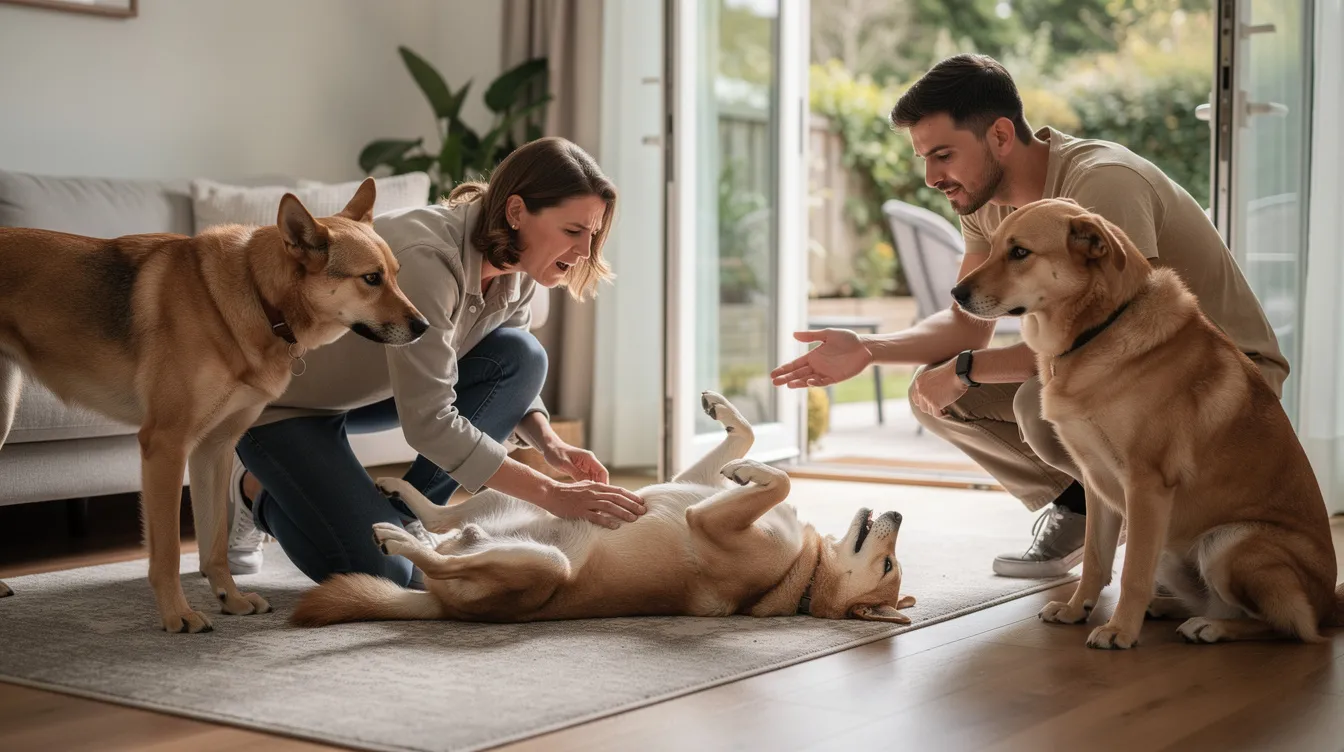
Rolling over requires careful context reading. A dog rolling over can indicate submission or appeasement rather than a request for belly rubs. In play, rollovers are dynamic and brief, with frequent role reversals. True submission is static and prolonged, with a lowered body and avoidance of eye contact. Before offering a belly rub, check whether the dog’s body is loose and wiggly or tense and frozen.
A loose and wiggly body posture indicates a relaxed and happy dog. Relaxed dogs have a loose, wiggly body posture with even weight distribution and no facial tension. Conversely, fearful dogs often exhibit lowered bodies and may try to make themselves smaller, with a lowered body, tail tucked between legs, and ears flattened.
Understanding these individual signals is valuable, but real-world application requires combining them systematically.
Advanced Interpretation Methods and Context Reading
Recognizing individual body signals is the foundation-but accurate interpretation requires combining multiple signals, accounting for context, and following a systematic assessment method. Understanding a dog’s emotional state requires observing behavioral changes across the entire body simultaneously.
Step-by-Step Body Language Assessment
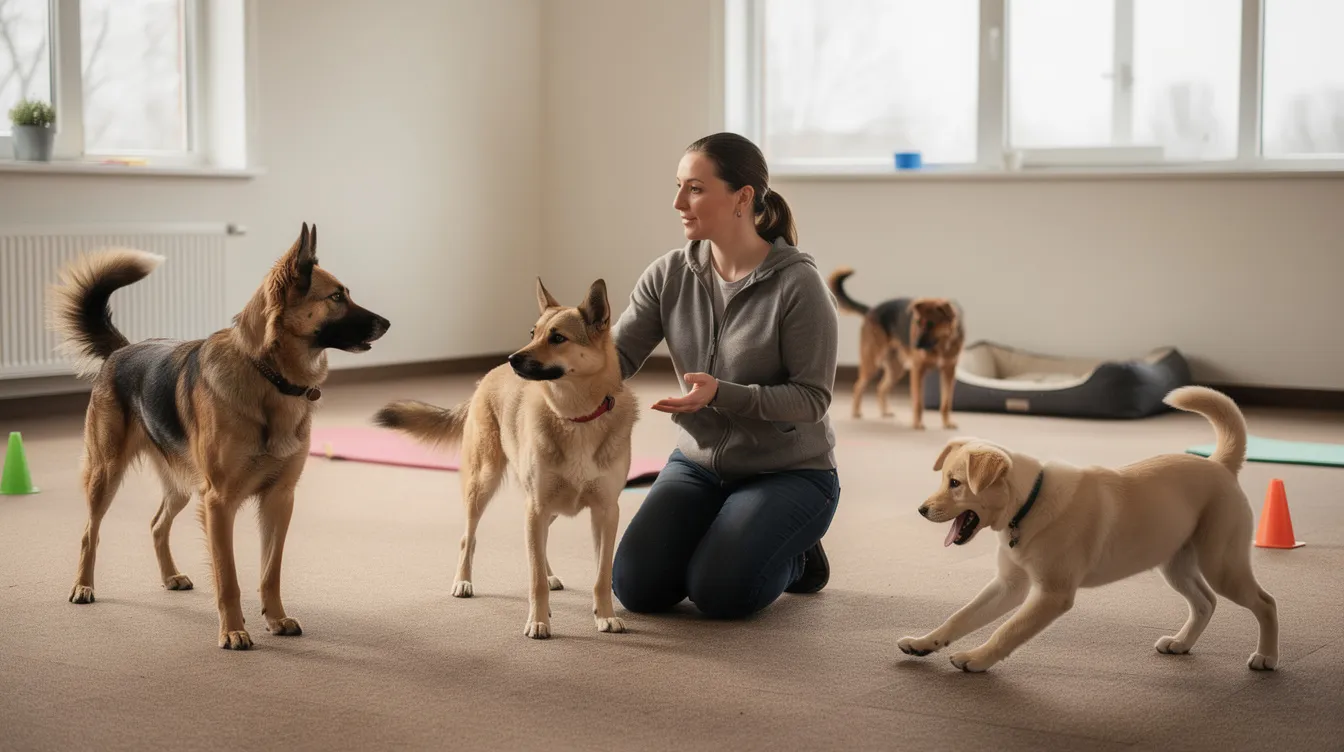
Use this systematic approach whenever you need to evaluate what a dog is communicating, especially with unfamiliar dogs, during walks, or in triggering environments:
- Observe overall energy and arousal level – Is the dog calm, energetic, hypervigilant, lethargic, or visibly stressed? Note pacing, trembling, excessive drooling, or self-grooming as arousal indicators.
- Check tail position and movement – Note whether the tail is high, neutral, or low. Assess wag speed, amplitude, and direction bias. Watch for a stiff versus loose wag.
- Assess facial tension and eye contact – Look for soft eyes versus a hard stare. Check for whale eye, blink rate, and whether the dog is avoiding direct eye contact. Note any lip licking, yawning, or nose licking.
- Note ear position relative to breed – Are ears forward, neutral, or pinned back? Account for breed-specific ear shape (erect versus floppy ears) and cropping.
- Evaluate body posture and weight distribution – Is the dog standing tall with weight shifted forward, relaxed with even distribution, or crouched with a lowered body? Check for raised hackles and overall muscle tension.
- Consider environmental context and triggers – What’s happening around the dog? Are other dogs, strangers, other animals, or unfamiliar objects present? Consider location (home versus park), distance to the trigger, past behavioral history, and whether the dog can move away from the perceived threat.
This multi-signal, context-aware assessment approach is standard in both ethological research and professional behavior modification practice.
Emotional State Comparison Chart
The following table synthesizes research-based patterns for the most common emotional states. Use it as a quick reference, but always evaluate the full context.
| Signal | Relaxed | Alert / Interested | Stressed / Nervous | Fearful / Submissive | Aggressive / Threatening |
|---|---|---|---|---|---|
| Tail | Mid-level, slow wide wag, loose | Tail up or forward, some wagging | Low or slightly tucked, small stiff wag | Tail tucked, minimal movement | High and stiff, possibly wagging rigidly |
| Ears | Natural position, slightly back | Erect or forward, rotated toward stimulus | Ears back or pinned, shifting | Ears back, flattened | Forward and stiff, or flattened depending on fear component |
| Eyes | Soft eyes, squinty, relaxed gaze | Focused gaze, eyes open wide | Whale eye, rapid blinking, avoidance | Eyes wide, averting gaze | Hard stare, fixed direct eye contact |
| Body Posture | Loose muscles, even weight, relaxed body | Forward lean, raised posture | Body low, cowering, pacing, trembling | Crouched, belly may be exposed, retreat | Rigid, chest elevated, weight shifted forward |
| Movement | Wiggly, natural pace | Stillness or controlled approach | Pacing, paw raise, self-grooming | Withdrawal, head turn, freezing | Lunging, snapping, stiff straight line approach |
Relaxed body language is characterized by loose muscles, natural posture, and soft eyes. Anxious dogs show the exact opposite pattern: tense body, displacement behaviors like lip licking and yawning, and avoidance signals. A nervous dog often displays a combination of a lowered body, ears back, and avoiding direct eye contact.
Research confirms that aggressive dogs show elevated heart rate and facial temperature alongside visible body signals like piloerection, left-biased tail wags, hard staring, and rapid barking. Physiological stress and visible signals work together.
When assessing any dog, your goal is to respond appropriately to the emotional state you observe-and recognize when signals don’t fit neatly into one category.
Common Interpretation Challenges and Solutions
Even experienced dog owners encounter situations where canine body language is difficult to read. Here are the most common challenges and practical solutions.
Misreading Mixed Signals
Dogs frequently display conflicting signals simultaneously. A dog approaches with a wagging tail but also shows flattened ears and a lowered body-is it friendly or afraid? This combination typically indicates conflict: the dog is excited but nervous. Tail wagging can indicate a variety of emotions depending on its speed and rigidity, so never rely on the wagging tail alone.
Solution: When you see mixed signals, prioritize the stress indicators. If any stress signals are present-whale eye, lip licking, a raised paw, frozen posture-treat the interaction as potentially uncomfortable for the dog. Giving troubled dogs space can help reduce their anxiety and stress. Watch for other signs like yawning, which can indicate a dog is stressed or anxious, or a dog shaking off, which can be a stress modulation behavior. For families navigating these situations at home, our guide to safe baby-dog interactions covers mixed signal reading in detail.
Breed-Specific Variations
Dogs with docked tails lose a primary communication tool. Breeds with floppy ears versus erect ears display ear position differently. Brachycephalic breeds (bulldogs, pugs) have compressed facial structures that limit visibility of wrinkles and lip movements. A husky’s erect ears and plume tail convey signals differently than a bulldog with droopy ears and a short tail.
Solution: Learn your individual dog’s baseline. Spend time observing your dog when it’s clearly relaxed-note how its ears sit, where its tail rests, and what its dog’s eyes look like in a calm state. This becomes your reference point. Any deviation from this baseline tells you the dog’s emotional state is shifting. Height, body shape, limb length, and even fur color or patterns can obscure body posture or hackle raising, so breed-specific baselines are essential.
Context-Dependent Behaviors
Similar-looking behaviors mean entirely different things depending on context. Growling during play versus growling over a food bowl are not the same signal. Dogs often display guarding behaviors when they feel their resources are threatened-a dog may show subtle cues like whale eye and rigid posture near a bone that would look entirely different during play.
Solution: Look for meta-signals that frame the interaction. Play includes play bows, role reversals, loose bouncy movement, and pauses. Aggression lacks these framing signals and features sustained tension, a stiff straight-line approach, and no reciprocity. Play growls tend to be higher-pitched and intermittent; aggressive growls are deeper and sustained. Recent research also shows that many human interactions labeled as affectionate-hugging, forcing attention, invading personal space-actually cause stress in dogs, especially with children. Sudden changes in a dog’s behavior can indicate pain or discomfort, warranting veterinary attention rather than behavioral correction.
Mastering these challenges is an ongoing process that deepens with daily practice and observation.
Conclusion and Next Steps
Dog body language is a learnable skill that directly impacts training success, family safety, and your dog’s welfare. Every signal-from a front paw raised in uncertainty to a relaxed body with a loose wagging tail-carries meaning when read in combination with other signals and environmental context. The key is moving beyond single-cue reading to whole-body, context-aware assessment. When you can accurately read what your dog is telling you, you can intervene before stress becomes reactivity and uncertainty becomes aggression.
Start building your body language literacy today:
- Practice daily observation – Spend 5 minutes watching your dog in different settings. Note its baseline posture, tail position, and ear placement when relaxed versus when a trigger appears.
- Start with one signal category – Master tail signals or facial expressions first before progressing to full-body assessment. Use the emotional state comparison chart above as a reference.
- Document concerning behaviors – If you notice early signs of reactivity, resource guarding, or fear-based aggression, record video and consult a professional trainer who can analyze the specific body signals in context.
For those working with reactive dogs or managing aggression concerns, professional guidance makes a significant difference. Related topics worth exploring include building a consistent daily training schedule, socialization methods for puppies, and training tips for families with kids and dogs.
Additional Resources
- Professional behavior consultation – Complex cases involving aggression, severe reactivity, or fear-based behaviors benefit from hands-on evaluation. Dog aggression training and puppy training programs provide structured support for owners in the Pittsburgh area.
- Continued learning – The AVSAB position statements on canine body language offer peer-reviewed resources for deeper study. Turid Rugaas’s work on calming signals remains a foundational reference for understanding appeasement behavior and subtle cues in dogs’ communication.
- Emergencies – If your dog shows sudden aggression, a significant behavioral change, or you feel unsafe, contact a professional trainer or veterinary behaviorist immediately. Do not attempt to manage dangerous behavior without expert support.