
Introduction
A puppy potty training timeline often extends across several months, with progress developing gradually as the puppy gains bladder control and learns where to eliminate. If you recently brought home a new puppy and want to know when accidents may become less frequent, this guide explains the common stages without presenting any age as a guaranteed deadline.
This complete age-based guide covers bladder development, weekly training progression, possible size-related differences, and realistic expectations for pet parents in Pittsburgh and beyond. Whether you are a first-time puppy owner, a family navigating house training with children, or someone whose puppy is progressing more slowly than expected, you will find practical steps for building reliable habits.
The direct answer: Many puppies show meaningful progress during their first few weeks of consistent training, but reliable house training commonly takes several months. Age, health, previous experience, access to an appropriate potty area, household routines, and individual development can all affect the timeline. Some puppies become dependable relatively quickly, while others need additional time or professional guidance.
Here is what you will gain from this guide:
- Realistic, age-based expectations for each stage
- Week-by-week milestones for monitoring progress
- Guidance on how size and individual development may affect training
- Troubleshooting strategies for setbacks and nighttime accidents
- Clear signs that veterinary or professional assistance may be needed
Understanding Puppy Potty Training Timeline Fundamentals
A puppy potty training timeline describes the progression from the day your puppy arrives home to the point when they consistently eliminate in an appropriate location and can wait for reasonable periods between bathroom breaks.
Being fully house-trained involves more than occasionally eliminating outdoors. The puppy must develop a preference for the designated location, learn the household routine, and gain sufficient physical control. Even a puppy who has gone several days without an accident may still require supervision in unfamiliar rooms or after changes to their schedule.
The timeline varies according to the puppy’s age, physical development, health, previous living environment, access to outdoor space, and the consistency of the household routine. Two puppies of the same age may progress at very different rates.
Bladder Development and Age Factors
Very young puppies have limited bladder control. Puppies generally develop stronger voluntary control at approximately 16 weeks, although individual development varies.
The commonly cited “age in months plus one hour” guideline can provide a rough estimate of the maximum time some older puppies may be physically capable of waiting. It should not be treated as a guaranteed holding time or as the recommended interval between daytime potty breaks. Active puppies often need to eliminate much sooner, particularly after eating, drinking, waking, or playing.
For example, an 8-week-old puppy may need to go outside every 30 to 60 minutes while awake, even if the puppy occasionally remains dry for longer while sleeping. As puppies mature, the intervals can be increased gradually based on their actual success rather than age alone.
Some puppies begin sleeping through the night as they approach 6 months, but others continue needing an overnight trip for longer. The AKC’s puppy potty training guidance emphasizes that puppies develop control gradually and that schedules should be adjusted to the individual puppy.
Training Consistency and the Timeline
Consistent supervision, management, and reinforcement can make potty training easier to understand. However, no reliable evidence shows that every puppy can be potty trained in seven days.
A predictable schedule helps owners anticipate when a puppy is likely to eliminate. Take the puppy to the designated location after waking, eating, drinking, active play, and other events that commonly trigger elimination. Reward the puppy immediately after they finish in the correct location.
When direct supervision is not possible, use an appropriately introduced crate, exercise pen, or puppy-safe area. Confinement should support safety and management, not serve as punishment.
Professional coaching may help owners identify gaps in scheduling, supervision, crate setup, and reinforcement. It cannot override physical development or guarantee that a puppy will become fully house-trained within a specific period. Pittsburgh owners who need individualized support can review available puppy training options.
Age-Based Potty Training Timeline Expectations
Puppy development does not follow an exact calendar, but age ranges can provide useful guidance. Adjust the schedule according to your puppy’s behavior, health, and accident history.
8-12 Weeks: Foundation Phase
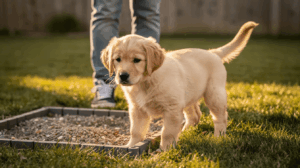
During the foundation phase, frequent bathroom trips and close supervision are essential. Many puppies in this age range need to go outside every 30 to 60 minutes while awake, as well as immediately after waking, eating, drinking, and active play.
Accidents are expected and should not be treated as defiance. At this age, puppies are still developing physical control and learning the household routine.
Training should focus on three priorities:
- Taking the puppy to a consistent, accessible potty area
- Rewarding immediately after elimination in the correct location
- Preventing unsupervised access to areas where accidents are likely
A crate or puppy-safe pen can assist with management when introduced gradually and positively. The area should allow the puppy to stand, turn around, and lie down comfortably.
Indoor pads are not automatically confusing. They may be useful for apartment residents, people with limited outdoor access, severe weather conditions, or puppies following veterinary restrictions. If your long-term goal is outdoor elimination, use a clear location and surface, then transition gradually rather than changing the rules unpredictably.
Additional crate-training and puppy-training basics can help owners establish a manageable early routine.
3-4 Months: Learning Phase
Between approximately 12 and 16 weeks, puppies may begin remaining dry for longer periods and showing more predictable elimination patterns. Some puppies can wait three to four hours under calm conditions, but active puppies may still need much more frequent opportunities.
You may notice early signals such as sniffing, circling, pacing, leaving a play area, approaching a door, or suddenly disengaging from an activity. These signals are not guaranteed, so continue using a schedule rather than waiting for the puppy to ask.
Introduce a consistent cue such as “go potty” while the puppy is beginning to eliminate. Reward immediately after the puppy finishes. Bell training can also be introduced, but owners should remember that some puppies learn to ring the bell simply to gain outdoor access.
Extend the time between scheduled trips gradually. If accidents increase, return to the previous successful interval instead of assuming the puppy is being difficult.
4-6 Months: Reliability-Building Phase
Many puppies become more dependable between 4 and 6 months, but this should be viewed as a reliability-building phase rather than guaranteed mastery.
As bladder control develops, some puppies can wait approximately four to six hours during the day under calm conditions. Others still need more frequent opportunities. Puppies approaching 6 months may begin sleeping through the night, although individual variation remains significant.
Continue supervising the puppy when introducing access to new rooms. Expand freedom gradually after a consistent period without accidents. If accidents return, reduce the puppy’s unsupervised area and increase scheduled bathroom trips.
Training during this phase should focus on:
- Maintaining a predictable schedule
- Practicing the potty routine in different appropriate locations
- Continuing immediate reinforcement
- Expanding household freedom gradually
- Monitoring for sudden changes that could indicate illness
House-training reliability should be evaluated by the puppy’s actual behavior, not by age alone.
Week-by-Week Training Implementation Timeline
Daily consistency creates the foundation for progress. A structured daily training schedule can help family members coordinate feeding, rest, play, and potty breaks.
Weeks 1-2: Intensive Management Period
The first two weeks require close supervision and a predictable routine. Indoor accidents should be cleaned thoroughly with an enzymatic cleaner to reduce lingering odors.
Daily schedule during weeks 1-2:
- Take your puppy outside every 30 to 60 minutes while awake, adjusting the interval according to age and recent accidents.
- Provide a potty opportunity after eating, drinking, waking, active play, and exciting interactions.
- Use a leash to guide the puppy to the designated area.
- Remain calm and limit distractions until the puppy eliminates.
- Reward immediately after successful elimination.
- Use direct supervision, an exercise pen, or a positively introduced crate when you cannot watch the puppy.
- Respond promptly to sniffing, circling, pacing, or attempts to leave the current area.
Many puppies need to eliminate shortly after eating. The exact interval varies, but taking the puppy outside within approximately 5 to 30 minutes after a meal is a practical starting point.
Expected progress: Your puppy may begin eliminating more quickly in the designated location and experiencing fewer accidents when closely supervised. An accident-free week should be treated as encouraging progress, not proof that supervision is no longer needed.
Success markers: Look for fewer accidents, longer dry periods, predictable elimination after routine events, and increasing interest in approaching the exit or designated potty area.
Weeks 3-4: Routine Recognition Period
During weeks 3 and 4, continue the established schedule while making small adjustments based on your puppy’s results.
Do not automatically increase the interval to two or three hours simply because two weeks have passed. Extend the schedule in small increments only after the puppy has remained successful at the current interval. If accidents return, shorten the interval again.
Continue taking the puppy out after meals, drinking, naps, play, and exciting events, even if scheduled breaks are becoming less frequent.
Some puppies begin developing a consistent signal during this period. Others do not signal reliably until much later. Owners should continue supervising and should not depend entirely on whining, bell ringing, or waiting by the door.
At night, provide a final potty opportunity immediately before bed. If the puppy wakes, becomes restless, or vocalizes at a predictable time, take them calmly to the designated location and return them to bed after elimination.
Months 2-3: Reliability-Building Period
During the second and third months of training, many puppies begin maintaining longer dry periods. Individual differences may become more noticeable at this stage.
A survey-based study of 735 dogs found that large dogs were more likely than small dogs to be reported as fully house-trained. However, the study did not establish exact age-based milestones or prove why the difference occurred.
| Factor | What You May Notice | Recommended Response |
| Smaller puppies | Some may need more frequent opportunities or take longer to develop consistent habits | Use shorter intervals and evaluate progress individually |
| Larger puppies | Some may remain dry for longer periods earlier in training | Continue supervision and avoid expanding freedom too quickly |
| Previous environment | Puppies raised without a defined sleeping or elimination area may need additional practice | Build a predictable routine without punishment |
| Home access | Apartment living, stairs, elevators, or distant outdoor areas can make timely trips more difficult | Plan ahead and begin each trip before the puppy becomes urgent |
These are general considerations, not guaranteed differences. Size alone cannot determine when a puppy will become reliable.
Continue expanding supervised freedom room by room. Maintain the same potty cue and designated location while providing immediate reinforcement after successful elimination.

Common Timeline Challenges and Solutions
Setbacks can occur during potty training, but they should be evaluated rather than automatically attributed to normal development.
For families with children and dogs, a written household schedule can help ensure that an adult is responsible for each planned potty trip.
Regression After Initial Progress
A puppy that was becoming reliable may begin having accidents after a schedule change, increased household freedom, travel, a new environment, disrupted supervision, or inconsistent access to the potty area.
Sudden regression can also be associated with urinary tract problems, digestive illness, increased urine production, pain, fear, anxiety, or other medical and behavioral concerns. It should not automatically be blamed on teething, growth spurts, neutering, or developmental fear periods.
Solution: Return temporarily to closer supervision and more frequent potty trips. Clean accidents with an enzymatic cleaner and reward successful outdoor elimination.
Contact your veterinarian if the change is sudden, persistent, or accompanied by straining, frequent small urinations, blood in the urine, increased thirst, diarrhea, vomiting, discomfort, or other symptoms. VCA’s guidance on house soiling explains that incomplete training, medical conditions, behavioral concerns, and marking can all contribute to indoor elimination.
Slower Progress Than Expected
Slow progress does not necessarily mean the puppy is resistant to training. Possible causes include missed potty opportunities, inconsistent supervision, an unclear designated location, long travel time to the outdoor area, fear of outdoor conditions, previous learning, or a medical concern.
Solution: Keep a written record of meals, water intake, naps, activity, potty trips, and accidents. Look for patterns that can help you adjust the schedule.
Make sure all family members follow the same routine. If accidents continue despite consistent management, consult your veterinarian before assuming the problem is purely behavioral. A puppy training consultation may also help identify practical gaps in the household routine.
Nighttime Accidents
Young puppies may need one or more nighttime potty trips. The ability to remain dry overnight develops gradually and should not be forced.
Solution: Provide a final potty opportunity immediately before bed and take the puppy out calmly if they wake or become restless overnight.
Do not routinely deprive a puppy of water for extended periods. Puppies should have adequate access to fresh water. If nighttime drinking or urination appears excessive, ask your veterinarian whether water intake or a medical problem needs to be evaluated.
Use a correctly sized crate or comfortable puppy-safe area. A crate should be large enough for the puppy to stand, turn around, and lie down naturally. It should not be made uncomfortably small to prevent accidents.
Persistent crate soiling may result from an overly long interval, distress during confinement, previous living conditions, diarrhea, urinary urgency, or another medical issue. Regular nighttime accidents that do not improve should be discussed with your veterinarian.
Conclusion and Next Steps
A realistic puppy potty training timeline depends on physical development, health, previous experience, household access, supervision, and consistent reinforcement. Many puppies make substantial progress during their first several months at home, but there is no universal date by which every puppy should be fully house-trained.
Monitor whether accidents are becoming less frequent and whether your puppy is developing predictable elimination patterns. Expand household freedom gradually and return to closer management if accidents increase.
Immediate next steps:
- Establish a schedule based on your puppy’s recent behavior, not only an age-based formula.
- Provide potty opportunities after waking, eating, drinking, play, and exciting interactions.
- Prepare an enzymatic cleaner, suitable rewards, a designated potty location, and a safe management area.
- Record meals, water intake, potty trips, and accidents to identify useful patterns.
- Increase the time between trips and expand household freedom only after consistent success.
- Contact your veterinarian if accidents are sudden, unusually frequent, painful, or accompanied by other symptoms.
If your puppy continues struggling with house training, crate routines, or everyday manners, review the available Pittsburgh puppy training programs or request a free consultation to discuss your puppy’s needs.
Frequently Asked Questions
How long does it typically take to fully potty train a puppy?
House training commonly takes several months, but there is no universal completion age. Some puppies make rapid progress, while others require longer because of physical development, previous experience, health, household access, or inconsistent routines.
Judge progress by whether accidents are becoming less frequent, the puppy eliminates predictably in the designated location, and supervised freedom can be expanded without setbacks.
When should I expect my puppy to sleep through the night without accidents?
Some puppies begin sleeping through the night as they approach 6 months, while others need nighttime trips for longer. Age, size, sleep duration, health, evening activity, and individual bladder development can affect overnight control.
Provide a final potty opportunity immediately before bed and respond calmly if your puppy wakes and appears to need to eliminate.
Is it normal for potty training to take longer with a smaller dog?
Some smaller dogs may require more frequent bathroom opportunities or a longer training period. Research has found an association between dog size and reported house-training completeness, but it has not established exact timelines or a single cause.
Living arrangements, outdoor access, training consistency, previous experience, and individual development may all contribute. Avoid labeling a puppy as stubborn because progress is slower than expected.
When should I be concerned about delayed potty training?
Seek veterinary guidance if your puppy strains to urinate, passes frequent small amounts, has blood in the urine, drinks or urinates excessively, develops diarrhea, appears painful, or suddenly regresses after making consistent progress.
Professional training assistance may be useful when the puppy is healthy but the household is struggling with scheduling, supervision, crate routines, outdoor fears, or consistent reinforcement. Age alone should not determine whether help is needed.
Can professional training shorten my puppy’s potty training timeline?
Professional coaching can help owners improve scheduling, supervision, reinforcement, crate setup, and household consistency. However, no professional program can guarantee a particular completion date or bypass a puppy’s physical development.
Choose a program that explains its methods clearly, sets realistic expectations, and recommends veterinary assessment when medical symptoms are present.
What can cause setbacks in an established potty training routine?
Setbacks may follow changes in schedule, reduced supervision, increased household freedom, travel, moving, a new pet or family member, outdoor fears, or inconsistent access to the designated potty area.
Medical problems can also cause accidents. If the change is sudden or accompanied by physical symptoms, arrange a veterinary examination. Otherwise, return temporarily to more frequent trips, closer supervision, and immediate reinforcement for successful elimination.